
Phonics Reading Drill Worksheets - Part 25: Word Endings Y, ER, EST & Poems
Comparative Endings and Y's Multiple Roles - A Poetic Celebration
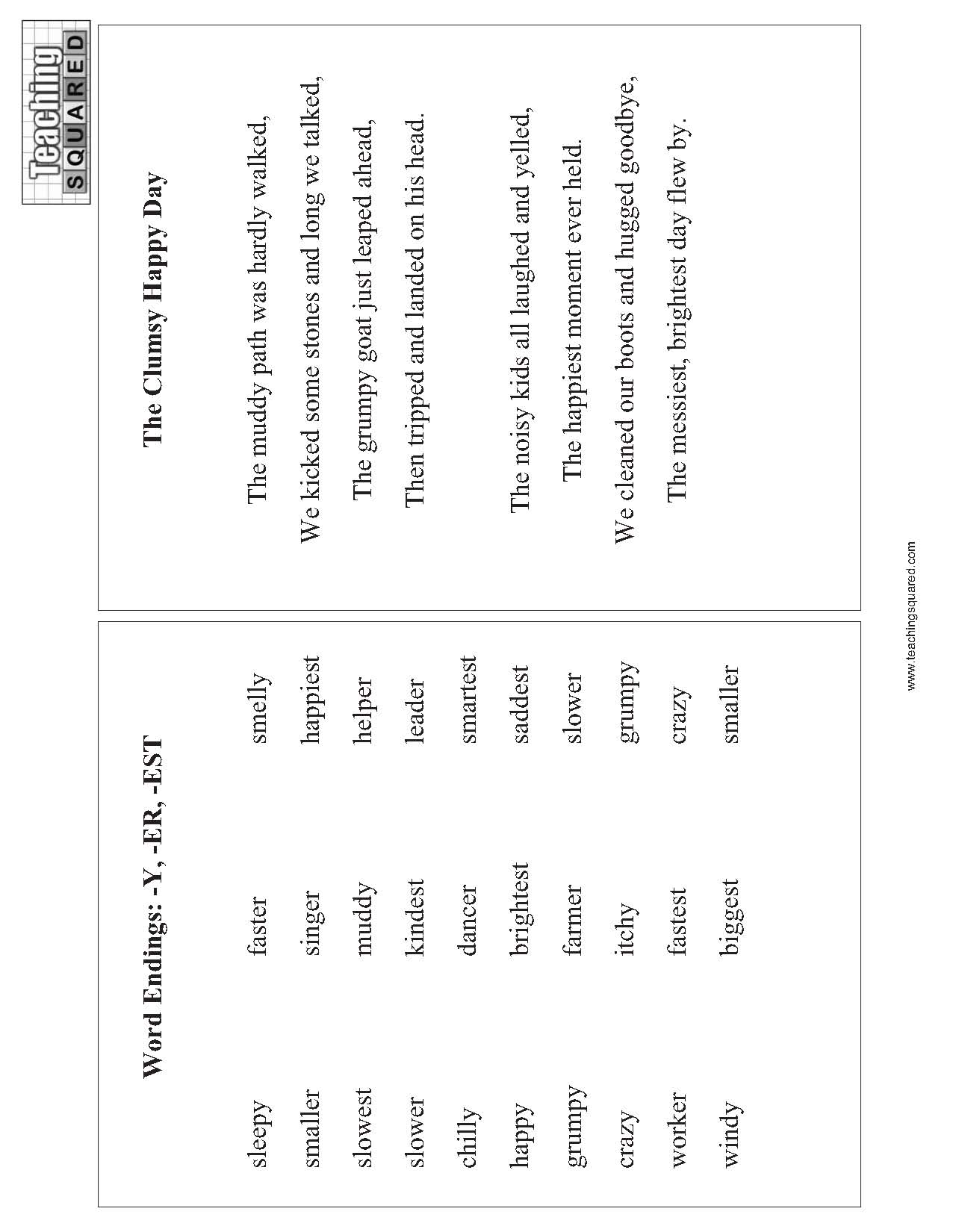
Advanced Suffixes and Y's Versatility Through Poetry
This sophisticated worksheet combines three important word endings with poetry reading, showcasing how suffixes change word meanings and create comparisons. The Y ending serves multiple purposes - making adjectives, creating the long E sound, and acting as a vowel. Through engaging poems, students discover how ER and EST create comparisons while celebrating their phonics achievements in verse.
What's Featured in This Worksheet:
- Y as Long E: happy, funny, silly, sunny, pretty, lucky, windy
- Y as Long I: fly, sky, try, my, by (review)
- Y Making Adjectives: rainy, cloudy, snowy, muddy, rocky
- ER Comparisons: bigger, smaller, faster, slower, happier, funnier
- EST Superlatives: biggest, smallest, fastest, slowest, happiest, funniest
- Poems incorporating all endings naturally
- Rhythm and expression practice
Learning Benefits:
- ✓ Masters Y's multiple functions
- ✓ Understands comparative suffixes
- ✓ Develops vocabulary for descriptions
- ✓ Builds grammar awareness through reading
- ✓ Enhances poetry fluency and expression
- ✓ Strengthens suffix pattern recognition
- ✓ Celebrates reading achievements
Understanding Y Endings
Y as a Vowel (Long E):
- At the end of multi-syllable words
- Makes long E sound: happy, funny, pretty
- Very common pattern
- Memory tip: "Y at the end sounds like E"
Y as a Vowel (Long I):
- At the end of one-syllable words
- Makes long I sound: my, fly, sky
- Less common but important
- Memory tip: "Short words, Y says I"
Y Making Describing Words:
- Added to nouns to make adjectives
- Rain → rainy, cloud → cloudy
- Shows "having the quality of"
- Changes word type and meaning
Comparative Endings: ER and EST
ER - Comparing Two Things:
- Shows "more than": bigger, faster, happier
- Compares two items or people
- Sometimes requires spelling changes
- Example: "Tom is taller than Sam"
EST - The Most or Least:
- Shows the extreme: biggest, fastest, happiest
- Compares three or more items
- The superlative form
- Example: "She is the tallest in class"
Sample Poems with Target Endings
Poem 1: "The Funny Day"
On a sunny, funny day,
The silliest children came to play.
Jenny jumps higher than a frog,
But Tommy jumps the highest of all!
They run faster through the park,
Until the sky grows dark.
Poem 2: "Weather Comparisons"
Monday was rainy, Tuesday was rainier,
But Wednesday was the rainiest day.
The clouds grew darker and darker still,
Making puddles bigger in every way.
My puppy got muddy, then muddier more,
The muddiest pup you ever saw!
Poem 3: "The Contest"
Who is funny? Who is funnier?
Who is the funniest of all?
My sister tells silly jokes,
My brother's are sillier still.
But grandpa is the silliest one,
He makes us laugh until we fall!
Spelling Patterns with ER and EST
Just Add ER/EST:
- tall → taller → tallest
- fast → faster → fastest
- slow → slower → slowest
Y Changes to I:
- happy → happier → happiest
- funny → funnier → funniest
- pretty → prettier → prettiest
Double the Consonant:
- big → bigger → biggest
- hot → hotter → hottest
- sad → sadder → saddest
Teaching Through Poetry
Expression Elements:
- Emphasize comparison words
- Use voice changes for different levels
- Act out comparisons while reading
- Make it playful and fun
Comprehension Focus:
- What is being compared?
- Which is more? Which is most?
- How do endings change meaning?
- Can you find all the Y words?
Common Challenges
- Y Sound Confusion: When Y says E vs. I - check syllables
- ER vs. EST: Understanding comparison levels - use visuals
- Spelling Changes: When to change Y to I - focus on reading first
- Poetry Flow: Maintaining fluency with new endings - practice repeatedly
Real-World Applications
These endings appear everywhere:
- Descriptions: happy, sunny, windy days
- Comparisons: bigger house, faster car
- Superlatives: best friend, tallest building
- Weather: rainy, cloudier, stormiest
Differentiation Strategies
For Struggling Readers: Focus on Y as long E first. Practice ER before EST. Use pictures showing comparisons. Read poems line by line first.
For Advanced Students: Explore irregular comparisons (good, better, best). Write original comparison poems. Find words where Y makes other sounds. Create superlative stories.
Assessment Points
- Can student read Y endings with correct sounds?
- Does student understand ER and EST meanings?
- Can student read comparison words fluently?
- Is student reading poetry with expression?
- Does student grasp how suffixes change meaning?
Celebrating Advanced Skills
This worksheet showcases students' ability to:
- Handle complex suffix patterns
- Understand grammatical concepts through reading
- Read poetry with comprehension and expression
- Apply all phonics skills in meaningful context
Master advanced suffixes through poetry - download this engaging final worksheet!