

Build confidence in early addition skills by learning to add 1 to various numbers. This foundational worksheet helps young mathematicians develop number sense and calculation fluency!

Strengthen number recognition and counting abilities through simple addition exercises. This worksheet introduces the concept of "one more" to help students understand sequential number patterns!

Take the next step in addition mastery by exploring skip counting patterns and double-digit thinking. This worksheet helps students develop mental math strategies for adding two to any number!

Enhance problem-solving abilities through systematic practice with adding 2. This engaging worksheet promotes mathematical reasoning and helps students discover efficient calculation methods!

Challenge arithmetic skills with progressively complex addition problems involving three. This worksheet builds mathematical stamina and prepares students for multi-step thinking processes!

Cultivate deeper mathematical understanding through strategic practice with adding 3. This worksheet encourages pattern discovery and helps students develop flexible thinking approaches to addition!

Expand numerical reasoning skills through consistent practice with adding 4. This worksheet promotes accuracy and speed while reinforcing essential addition facts for mathematical success!

Advance critical thinking abilities through targeted exercises with adding 4. This worksheet develops logical reasoning and helps students internalize important mathematical connections!

Develop automatic fact recall through meaningful practice with adding 5. This worksheet introduces benchmark number strategies and builds the foundation for efficient mental calculations!

Solidify mathematical concepts through structured exploration of adding 5. This worksheet reinforces number bonds and promotes deep conceptual understanding of addition relationships!

Strengthen arithmetic mastery through progressive practice with adding 6. This worksheet builds fact family knowledge and develops rapid computation skills for intermediate learners!

Refine computational precision through systematic practice with adding 6. This worksheet develops algorithmic thinking patterns and enhances mathematical accuracy for confident calculation!

Excel in advanced arithmetic through challenging practice with adding 7. This worksheet pushes mathematical boundaries and cultivates expert-level calculation skills for ambitious learners!

Optimize mathematical performance through intensive training with adding 7. This worksheet fosters strategic computation methods and develops analytical problem-solving techniques for mathematical excellence!

Perfect mathematical operations through rigorous practice with adding 8. This worksheet develops sophisticated calculation strategies and builds numerical expertise for comprehensive mathematical understanding!

Maximize learning potential through dynamic exploration of adding 8. This worksheet cultivates innovative thinking approaches and helps students master complex numerical relationships with creativity!

Achieve mathematical excellence through specialized practice with adding 9. This worksheet introduces near-double strategies and develops advanced computational thinking for superior calculation abilities!

Transform mathematical understanding through strategic exploration of adding 9. This worksheet reveals powerful pattern shortcuts and teaches efficient calculation methods for lightning-fast computation!

Master fundamental place value concepts through essential practice with adding 10. This worksheet establishes base-ten understanding and develops instant mental calculation skills crucial for mathematical growth!

Unlock number system mastery through comprehensive exploration of adding 10. This worksheet strengthens place value reasoning and develops essential decimal understanding for advanced mathematical success!

Mermaids Advanced Addition

SuperMathLand Addition Game
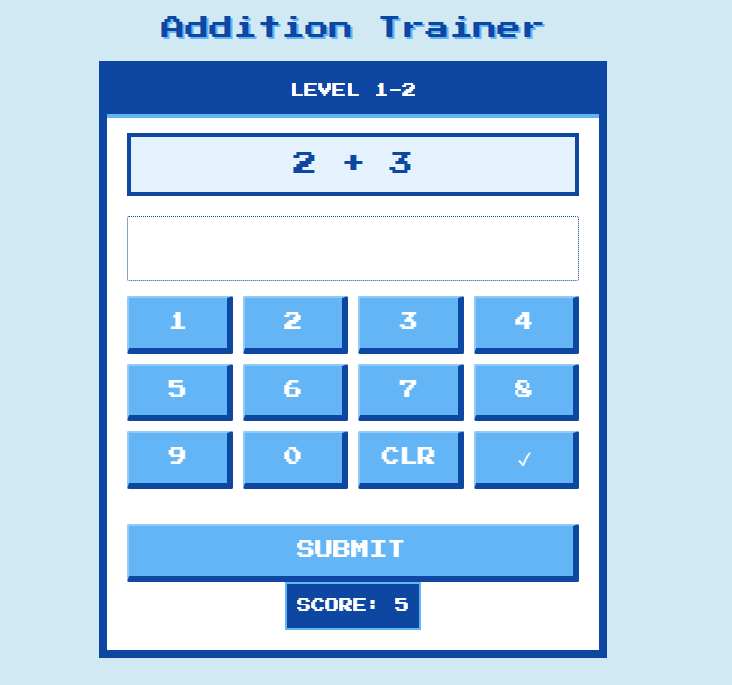
Basic Addition Trainer - 8-Bit Academy