
Phonics Reading Drill Worksheets - Part 23: OO, UE, EW & Silent Letters GN, KN, WR
The /oo/ Sound Family and Silent Letter Mysteries
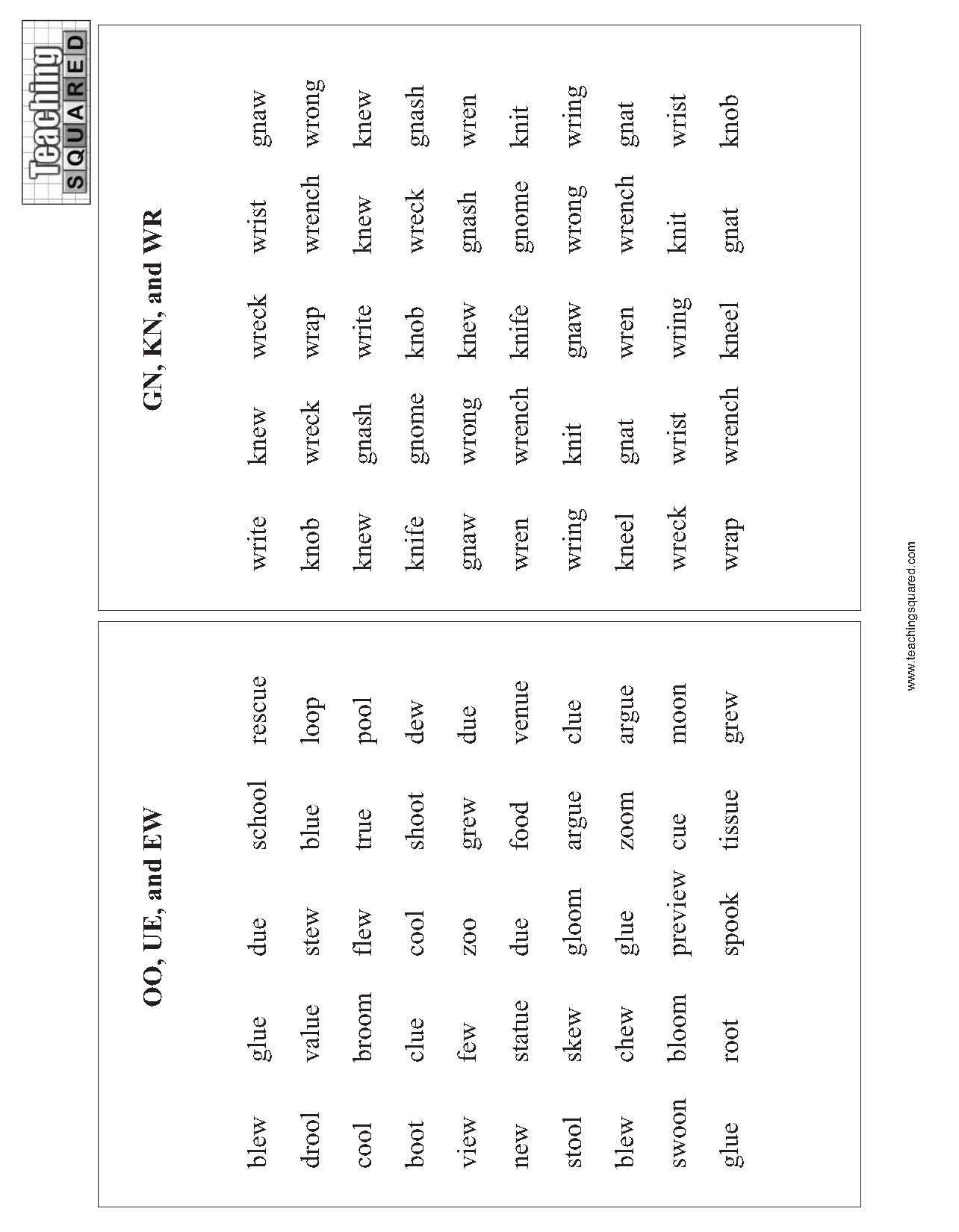
Advanced Patterns: Multiple /oo/ Spellings and Silent Consonants
This sophisticated worksheet tackles two complex phonics concepts: the multiple spellings of the /oo/ sound (which also has two pronunciations) and silent letter combinations at the beginning of words. These advanced patterns appear in many common words and require careful attention to visual patterns rather than just sound. Part 23 develops visual memory and pattern flexibility essential for proficient reading.
What's Featured in This Worksheet:
- OO Pattern: moon, soon, food, room (long /oo/) and book, good, look (short /oo/)
- UE Pattern: blue, true, clue, glue, Tuesday, rescue
- EW Pattern: new, few, grew, flew, drew, threw, knew
- GN Words: gnome, gnat, gnaw, sign, design
- KN Words: know, knee, knife, knight, knock, knit
- WR Words: write, wrong, wrap, wrist, wreck, wrote
- Sentences mixing all patterns
Learning Benefits:
- ✓ Masters complex /oo/ sound patterns
- ✓ Develops visual pattern recognition
- ✓ Learns silent letter combinations
- ✓ Builds vocabulary with irregular spellings
- ✓ Strengthens memory for visual patterns
- ✓ Improves spelling-sound relationships
- ✓ Prepares for advanced English spelling
Understanding the /oo/ Sound Patterns
The Two OO Sounds:
- Long /oo/ (like "moon"): room, soon, food, school, pool
- Short /oo/ (like "book"): good, look, cook, foot, wood
- No clear rule - must learn by word families and practice
UE Pattern:
- Usually makes long /oo/ sound: blue, true, glue
- Often at word endings
- Very consistent pattern
- Memory tip: "UE is true blue"
EW Pattern:
- Makes long /oo/ sound: new, flew, grew
- Sometimes makes /yoo/ sound: few, view
- Often at word endings
- Memory tip: "EW flew in new"
Silent Letter Combinations
Why Silent Letters? English borrowed words from other languages and kept their spellings, even when pronunciation changed.
GN Pattern:
- G is silent, only N sounds: gnome, gnat
- Also silent in -IGN endings: sign, design
- Memory tip: "Gnomes are gsilent"
KN Pattern:
- K is silent, only N sounds: know, knee
- Very common in everyday words
- Memory tip: "I know K is silent"
WR Pattern:
- W is silent, only R sounds: write, wrong
- Common in writing-related words
- Memory tip: "Write without the W sound"
Common Words by Pattern
OO Words (both sounds):
- Long /oo/: moon, soon, room, food, pool, cool, school
- Short /oo/: book, look, good, cook, foot, wood, hood
Silent Letter Words:
- GN: gnome, gnat, gnaw, gnu, sign, design, resign
- KN: know, knew, knee, knife, knight, knock, knit, knot
- WR: write, wrong, wrap, wrist, wreck, wrote, wrinkle
Sample Sentences
- "I knew the blue moon would look good tonight." (EW, UE, OO, OO)
- "The knight could write with his left hand." (KN, WR)
- "She took a good book to read in her room." (OO short, OO long)
- "Did you know it's wrong to wrap the gift in blue?" (KN, WR, UE)
- "The cook knew a few good recipes for Tuesday." (OO, KN, EW, OO, UE)
- "A gnat flew near the sign by the pool at noon." (GN, EW, GN, OO, OO)
Teaching Strategies
For /oo/ Patterns:
- Group by sound (long vs. short OO)
- Teach UE and EW as "usually long /oo/"
- Use word families for OO variations
- Create visual charts showing patterns
For Silent Letters:
- Emphasize visual memory over sounding out
- Make it fun - "sneaky silent letters"
- Practice common words repeatedly
- Connect to meaning when possible (knight = fighter)
Common Challenges
- OO Confusion: Which sound to use - provide word family lists
- Forgetting Silent Letters: Students sound them out - emphasize visual pattern
- EW Variations: Sometimes /oo/, sometimes /yoo/ - teach common words
- Spelling Transfer: Remembering silent letters when writing - focus on reading first
Memory Aids
- OO: "Book and look" (short) vs. "Moon and soon" (long)
- Silent K: "I know my knee" - both have silent K
- Silent W: "Write it right" - W is silent
- Silent G: "Gnomes gnaw gsilently"
Differentiation Approaches
For Struggling Readers: Focus on most common words first (know, write, new). Separate OO sounds into different lessons. Use mnemonics and visual cues. Practice silent letter words as sight words.
For Advanced Students: Explore word origins (why K in knife?). Find more OO words and sort by sound. Create silent letter dictionaries. Write stories using target patterns.
Assessment Guidelines
- Can student distinguish between OO sounds?
- Does student recognize UE and EW patterns?
- Can student read silent letter words automatically?
- Is student developing visual pattern memory?
- Does student maintain fluency with these complex patterns?
Real-World Importance
These patterns appear in essential vocabulary:
- School words: school, room, book, write, knew
- Daily activities: food, good, look, know
- Action words: took, stood, flew, grew, wrote
- Question words: knew, know (past and present)
Advanced Pattern Mastery
Successfully reading these patterns demonstrates:
- Flexibility with sound-spelling relationships
- Strong visual memory for words
- Readiness for irregular English spelling
- Ability to handle complex patterns
Master complex patterns and silent letters - download this advanced phonics worksheet!