
Phonics Reading Drill Worksheets - Part 8: Plurals - Adding S & Review Sentences
Understanding Word Changes and Grammar Patterns in Reading
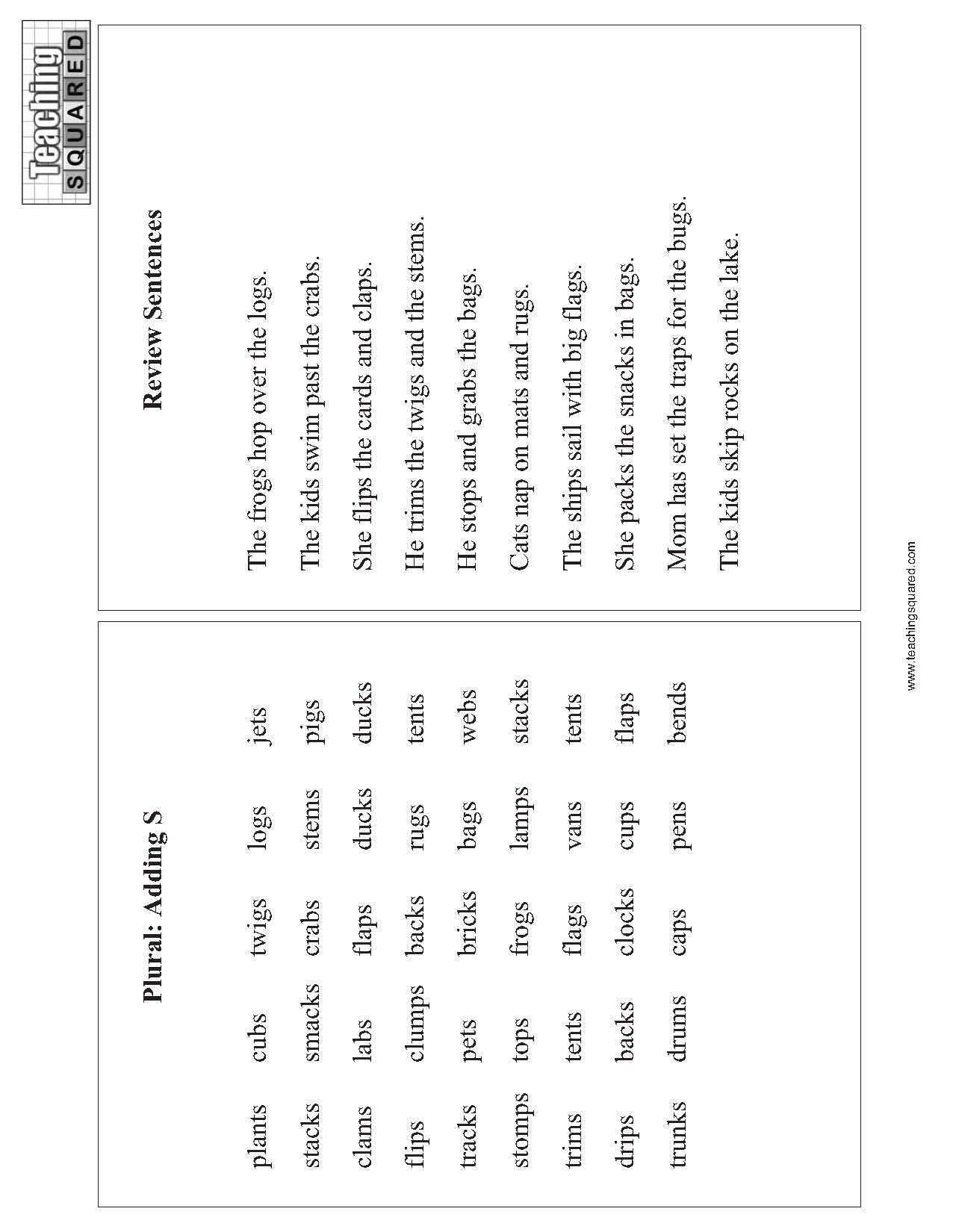
From Single to Multiple: Understanding Plural Forms
This worksheet introduces a crucial reading concept - how words change to show "more than one." By learning to recognize and read plural forms, students expand their decoding skills beyond individual words to understanding word relationships and meaning. Part 8 combines plural instruction with sentence practice, helping students see how grammar affects both reading and comprehension.
What's Featured in This Worksheet:
- Simple Plurals: Adding -s to familiar words (cat→cats, dog→dogs, book→books)
- Plural Blends: Words ending in blends + s (hand→hands, tent→tents)
- Vowel Sound Changes: How adding -s affects pronunciation
- Sentences contrasting singular and plural forms
- Number words paired with plural nouns
- Visual cues showing one vs. many
- Mixed review sentences with all learned patterns
Learning Benefits:
- ✓ Introduces morphological awareness (word parts)
- ✓ Builds understanding of grammar in reading
- ✓ Develops concept of singular vs. plural
- ✓ Strengthens comprehension through meaning changes
- ✓ Prepares for other word endings (-es, -ed, -ing)
- ✓ Reinforces counting and number concepts
- ✓ Enhances vocabulary through word relationships
Teaching Plurals Effectively
Core Concept: Explain that -s is like a "more than one" signal. When we see -s at the end of a naming word (noun), it usually means there's more than one. Use visual examples: 1 cat vs. 3 cats with pictures.
Introduction Steps:
- Step 1: Start with concrete objects students can see and count
- Step 2: Practice listening for the /s/ or /z/ sound at word endings
- Step 3: Show how the word looks different in print
- Step 4: Read sentences that show the meaning difference
Plural Patterns on This Worksheet
Basic Plurals:
- CVC words + s: cats, dogs, hats, maps, rugs
- Blend words + s: frogs, clocks, plants, stamps
- Words with /s/ sound: cats, hats, maps, tops
- Words with /z/ sound: dogs, bugs, frogs, pens
Sample Sentences:
- "I see one cat. I see two cats."
- "The dog runs. The dogs run fast."
- "Three frogs jump on the rocks."
- "Many birds sit in the tall trees."
Teaching the S Sound Variations
The /s/ Sound: After voiceless consonants (p, t, k, f) - cats, tops, cliffs
The /z/ Sound: After voiced consonants (b, d, g, m, n, l, r) and vowels - dogs, drums, cars
Don't overwhelm students with rules - let them develop an ear for the difference through practice.
Common Challenges and Solutions
- Forgetting to Read the -s: Use a pointer to track each letter, emphasize the ending
- Confusion with Possessives: At this stage, focus only on plurals for "more than one"
- Overgeneralizing: Students may add -s to verbs; gently correct and explain
- Number Agreement: Practice matching number words with plural forms
Activities for Plural Practice
Singular/Plural Sort: Sort picture cards or objects into "one" and "more than one" groups. Add labels with correct spelling.
Plural Hunt: Find plural words in classroom books. Make a chart of discovered plurals.
Number Sentences: Create sentences using number words: "Five (frogs) sit on a log."
Differentiation Strategies
For Struggling Readers: Use manipulatives to show one vs. many. Focus on hearing the ending sound before reading. Provide picture support for all plural words.
For Advanced Students: Introduce irregular plurals for awareness (children, mice). Explore -es endings for words ending in s, x, ch, sh. Create plural word families.
Assessment Guidelines
- Can student identify when a word shows "more than one"?
- Does student consistently read the -s ending?
- Can student match plural words with correct numbers?
- Does student understand sentence meaning changes with plurals?
- Is student beginning to use plurals in their own writing?
Connection to Writing
This worksheet naturally bridges to writing skills. As students read plurals, they begin to understand when to add -s in their own writing. Encourage students to write sentences about multiple objects, reinforcing both reading and writing of plural forms.
Looking Ahead
Mastering basic plurals prepares students for more complex word endings: -es plurals, past tense -ed, continuous -ing, and comparative endings. This foundational understanding of how words change to show meaning is crucial for reading development.
Help your students understand how words change meaning - download this plural practice worksheet today!